
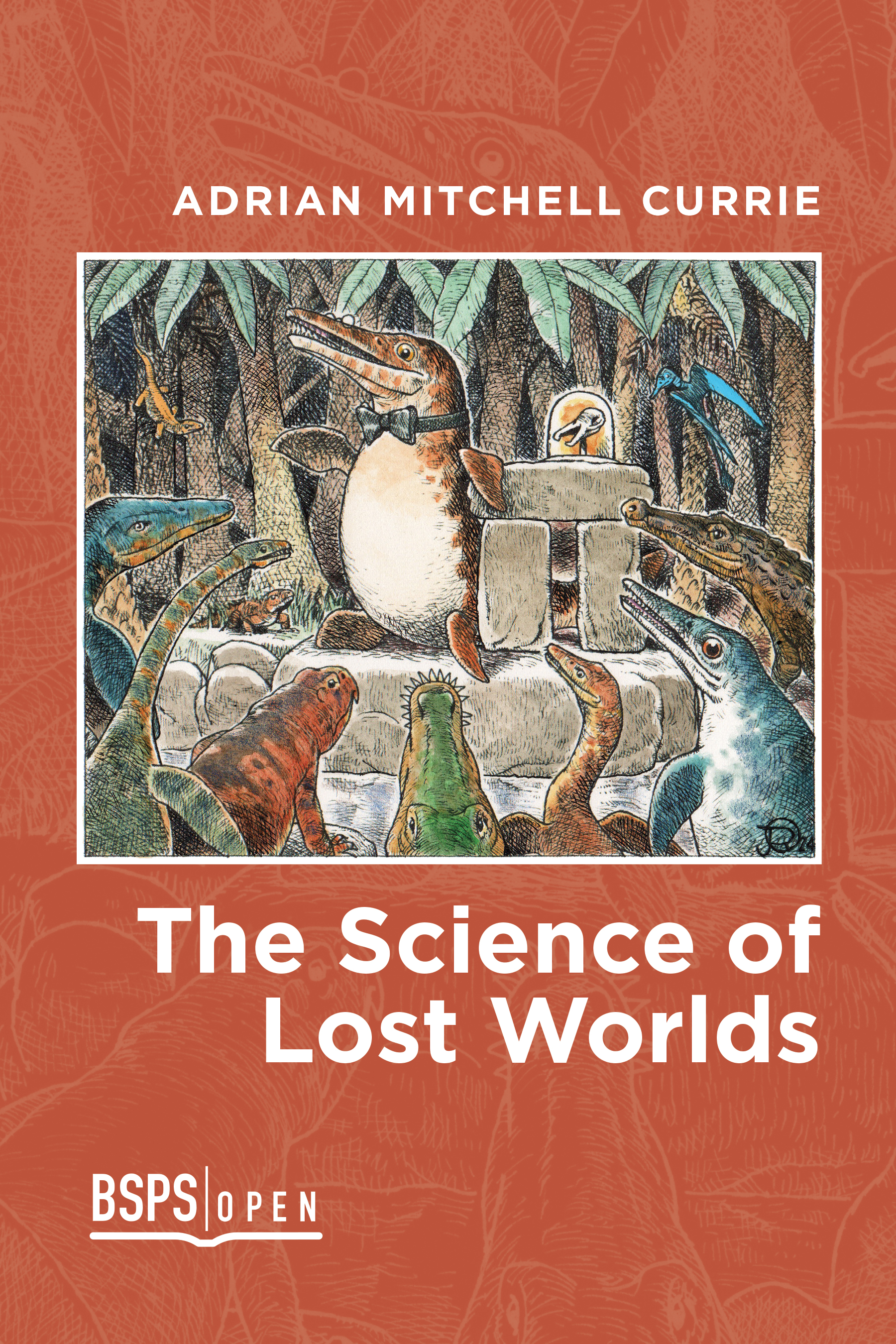
The Science of Lost Worlds
Adrian Mitchell Currie, with illustrations by Jim Robins
$168.99 HC / $59.99 PB (T)
384 pages, 35 illustrations
6 x 9 inches
Hardback: 978-1-77385-709-1
Paperback: 978-1-77385-710-7
Epub: 978-1-77385-711-4
Library PDF: 978-1-77385-712-1
October 1, 2026
Sometimes the past is hard to know because it leaves only traces Sometimes the past is hard to know because it is weird. Join author Adrian Mitichell Currie, illustrator Jim Robins, and the irrepressible Prof. Ichthy to discover how we come to know what we know about the deep past.
How do we understand the past when the past is weird: populated by different creatures and different environments, playing by different rules?
In The Science of Lost Worlds, Adrian Mitchell Currie and the fantastical Prof. Ichthy explore the epistemology of the historical sciences. They show how paleontologists creatively adopt perspectives that link the unfamiliar past with the familiar present through a variety of interlocking, iterative strategies that combine imagination and hard science to discover lost worlds.
Considering science, art, and the materiality of paleontological practice, Currie develops an artifactualist account of this scientific imagination. They explore the metaphysical upshots of paleontological practice, the deeply modal nature of paleontological knowledge, and how the science of the deep past is about deep possibility. Currie compares our knowledge of the past to our knowledge of the future, arguing that the peculiarity of the future profoundly limits our capacity to know it
The Science of Lost Worlds is an exploration of palaeontologic practice and reasoning that reflects and amplifies the ability of the deep past to generate wonder.
Adrian Mitchell Currie is an associate professor of philosophy at Exeter university. Their primary interest is how scientists successfully generate knowledge in tricky circumstances, where evidence is thin on the ground, targets are highly complex, and information is limited. They are the recipient of the Philip Leverhulme award, and their monograph Rock, Bone & Ruin: An Optimist’s Guide to the Historical Sciences won the Fernando Gil International Prize for Philosophy of Science.