
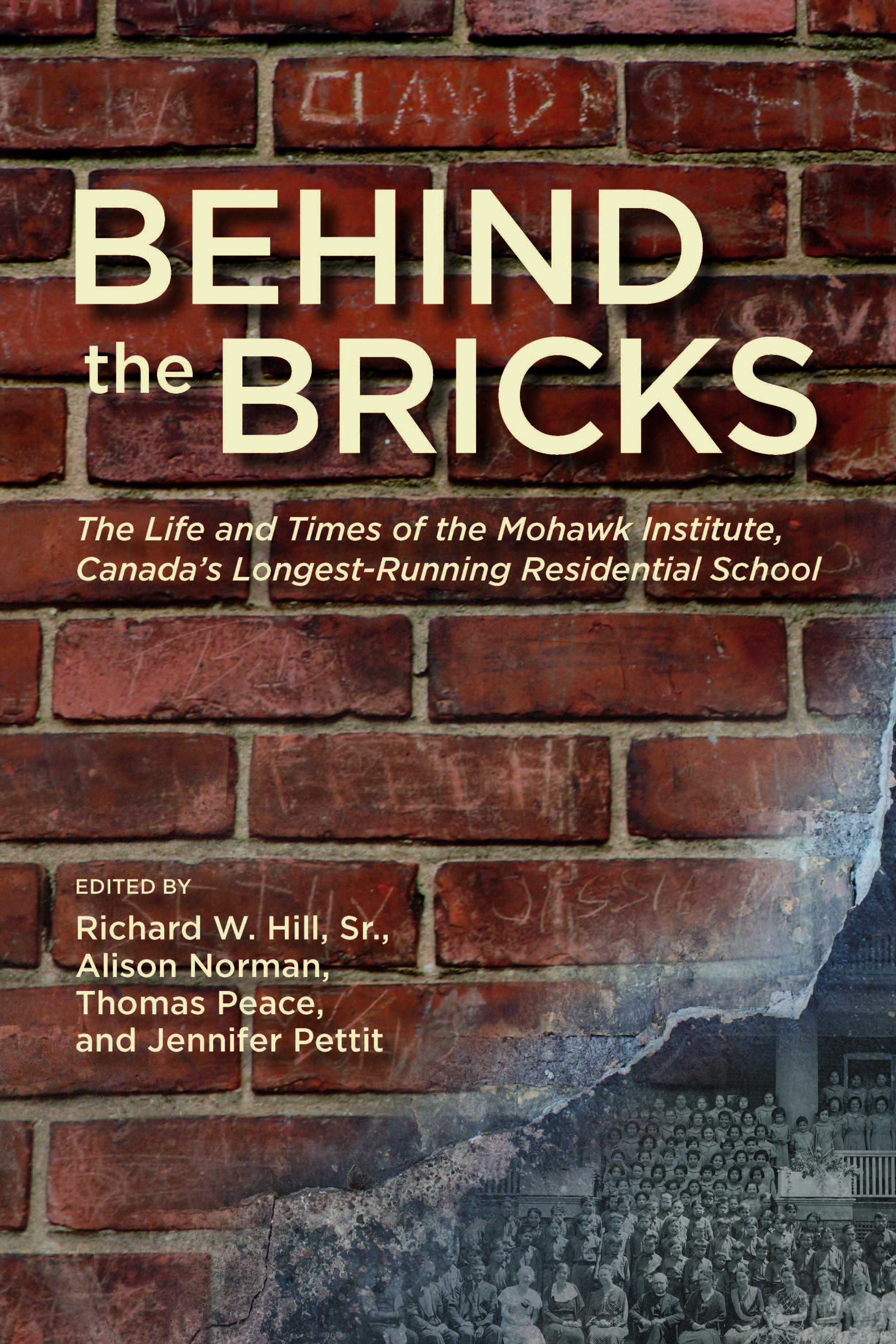
Behind the Bricks: The Life and Times of the Mohawk Institute, Canada’s Longest-Running Residential School
Edited by Richard W. Hill Sr., Alison Norman, Thomas Peace, and Jennifer Pettit
$84.99 HC / $42.99 PB
402 pages, 89 illustrations
6 x 9 inches
Hardback: 978-1-77385-651-3
Paperback: 978-1-77385-652-0
Epub: 978-1-77385-655-1
Library PDF: 978-1-77385-654-4
September 2025
Behind the Bricks is the story of the Mohawk Institute, Canada’s first and longest-running residential school and a model for the entire residential school system.
From the outside, the Mohawk Institute looks like a large and welcoming school building. When one looks behind the bricks of the school, however, a much different story becomes apparent. Conceived and overseen by Six Nations community member Richard W. Hill Sr., Behind the Bricks is an important work that provides deep insight into the Mohawk Institute, Canada’s first, and longest-running, residential school, operating from 1828 to 1970 in Brantford, Ontario. Many see the Mohawk Institute as a model for the residential school system.
Behind the Bricks brings together Indigenous and non-Indigenous experts. The book begins with an overview that traces the history and context of the school, and the remainder of Behind the Bricks touches on a broad array of topics from the experiences of students, to archaeology and architecture, to the role of religion, and beyond, drawing on a wide variety of sources including government documents, church records, and oral history.
Behind the Bricks examines the policies and motivations that shaped the experiences of all three parties involved with the school—the government, the church, and the students and their communities.
A thorough and thoughtful history that provides deep insight into over a century of institutional operation, Behind the Bricks is an essential work that tells us not only about the Mohawk Institute, but the entire residential school system, providing a window into the past with the goal of working towards a future of truth and reconciliation.
With contributions by: William (Bill) Acres, Diana Castillo, Sarah Clarke, Jimmie Edgar, Wendy L. Fletcher, Bonnie Freeman, Tara Froman, Alexandra Giancarlo, Cody Groat, Evan J. Habkirk, Richard W. Hill Sr., Keith Jamieson, Sandra Juutilainen, Magdalena Miłosz, David Monture, Teri Morrow, John Moses, Alison Norman, Thomas Peace, Jennifer Pettit, Paul Racher, and Bud Whiteye.
About the Editors
Richard W. Hill Sr., Tuscarora Nation of the Haudenosaunee, is a community-based historian at Six Nations of Grand River.
Alison Norman is a settler historian who works for the federal government at Crown-Indigenous Relations and Northern Affairs Canada.
Thomas Peace is an historian at Huron University College and an editor at ActiveHistory.ca.
Jennifer Pettit is Dean of the Faculty of Arts and professor of History and Indigenous Studies at Mount Royal University.
Behind the Bricks advances historical research in its critical and sweeping presentation of the records kept on the Mohawk Institute. Tracing the story of one residential school illustrates the powers and violences of Canada’s residential school system writ large
—Canadian Historical Review
Behind the Bricks is a rich and valuable text that underscores the importance of interrogating local and regional specificities in Canada’s IRSS history.
—Ontario History
This book provides a powerful reminder that to have truth and reconciliation we must not only read these things but know these things and change our lives in this knowledge. Let us listen, learn, and act.
—The Seaboard Review
As someone from a Michi Saagiig Nishnaabeg community who also had its youth sent to the Mohawk Institution, this collection has assisted me in connecting further with my roots and the sheer amount of perseverance that is not only showcased by Six Nations today but also my own community.
—Chadwick Cowie, Journal of Australian Canadian & Aotearoa New Zealand Studies
A rich and diverse set of insights Behind the Bricks of the Mohawk Institute.
—J.R. Miller, professor emeritus, University of Saskatchewan
Behind the Bricks offers an important examination of Canada’s longest-running residential school, the Mohawk Institute. As we continue to reckon with the legacy of colonial schooling, this timely collection helps to model how to put truth before reconciliation.
—Sean Carleton, associate professor of history and Indigenous studies, University of Manitoba
Drawing on a wide range of sources including photographs, maps, Survivor interviews, archaeological remains, newspapers, and government and personal correspondence, this unique collection of essays by Indigenous and non-Indigenous colleagues and peers examines the long history of the land, buildings, people, and ideas connected with the Mohawk Institute. Behind the Bricks lay an intersection of Six Nations, the New England Company, the Canadian government, and the struggle over First Nations education.
—Mary Jane McCallum, professor, Department of History, University of Winnipeg
SHORTLISTED, Alberta Book PUblishing Scholarly & Academic Book of the Year | 2026